Be yourself; Everyone else is already taken.
— Oscar Wilde.
This is the first post on my new blog. I’m just getting this new blog going, so stay tuned for more. Subscribe below to get notified when I post new updates.
Carbon Dioxide
Be yourself; Everyone else is already taken.
— Oscar Wilde.
This is the first post on my new blog. I’m just getting this new blog going, so stay tuned for more. Subscribe below to get notified when I post new updates.
Carbon dioxide (CO2) levels have fluctuated through cycles naturally over thousands of years, between 180 and 300 Parts per million (ppm). The problem is that since the 1950’s we have passed the 300 PPM level and have never looked back. In fact we have just recently passed the 400 ppm barrier in 2015. CO2 does play a necessary role in making earth habitable. Without CO2 and the other greenhouse gases the temperature on earth would be too cold to inhabit. Thus it’s not about eliminating CO2 but rather getting earth back to a level that reduces the negative impacts of rising CO2 levels.
The chart in figure 1 shows the levels of CO2 in parts per million as recorded by the Mauna Loa Observatory, Hawaii. It shows the consistent increase of CO2 levels over the last 60 years.
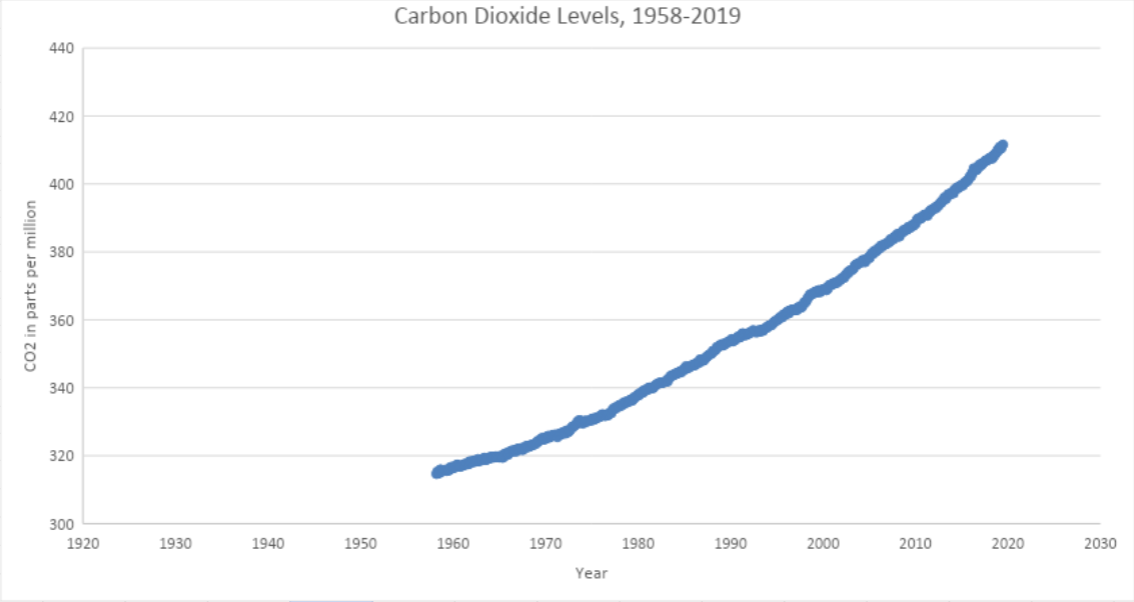
Figure 1
This increase in CO2 can be traced to three main sources controlled by humans. According to Our world in Data electricity and heat production, transport, manufacturing industries and construction make up approximately 90% of the CO2 in our atmosphere (Ritchie and Roser 2017). While there are many negative effects that rising CO2 levels have on the earth. The one that I links many of them together is the rising temperature also known as global warming. Unfortunately this is a topic that many people don’t believe is true or since it doesn’t have a huge impact on their personal lives don’t see it necessary to make a big deal about. The danger in rising temperatures is not just in regards to the heat itself. Although heat waves “are responsible for more deaths in the US every year than the combined effects of hurricanes, lightning, tornadoes, earthquakes, and floods” (Loria 2018). Being an avid outdoors person, I encounter ticks and mosquitos more regularly than the average person does. These pesky critters aren’t active in the colder months. So if the world gets warmer they are able to increase their range and length of time they spread disease (Loria 2018). These diseases won’t be just something that someone like myself has to be concerned about. Eventually everyone will have to take this risk into consideration whenever they go to their car, go for a walk, sit outside, play at the park, etc…
Since the main contributors to the rising levels of CO2 are electricity and heat production, transport, manufacturing industries and construction. I believe that every change begins with the mindset of each individual person that makes up the whole. The following questions arise for an individual, companies and communities to solve this problem. What can the individual and community do on a daily and yearly basis to minimize their CO2 production from transportation? What can an energy company do to help encourage individuals to reduce the amount of CO2 production from heating or cooling their home? What other sources of energy can be utilized to provide electricity? Investigating other materials and methods in the manufacturing industries and construction. These questions are just the tip of the iceberg and one of the steps to move in the right direction as a global community was the creation of the Paris Agreement.
References
Loria, K. (2018, May 9). Earth has crossed a scary threshold for the first time in more than 800,00 years, and it could lead to tens of thousands of deaths. Business insider. Retrieved from https://www.businessinsider.com/how-atmospheric-carbon-dioxide-affects-health-2018-5
Ritchie, H. Roser, M (2017, May). CO2 and other greenhouse gas emissions. Retrieved from https://ourworldindata.org/co2-and-other-greenhouse-gas-emissions
This is an example post, originally published as part of Blogging University. Enroll in one of our ten programs, and start your blog right.
You’re going to publish a post today. Don’t worry about how your blog looks. Don’t worry if you haven’t given it a name yet, or you’re feeling overwhelmed. Just click the “New Post” button, and tell us why you’re here.
Why do this?
The post can be short or long, a personal intro to your life or a bloggy mission statement, a manifesto for the future or a simple outline of your the types of things you hope to publish.
To help you get started, here are a few questions:
You’re not locked into any of this; one of the wonderful things about blogs is how they constantly evolve as we learn, grow, and interact with one another — but it’s good to know where and why you started, and articulating your goals may just give you a few other post ideas.
Can’t think how to get started? Just write the first thing that pops into your head. Anne Lamott, author of a book on writing we love, says that you need to give yourself permission to write a “crappy first draft”. Anne makes a great point — just start writing, and worry about editing it later.
When you’re ready to publish, give your post three to five tags that describe your blog’s focus — writing, photography, fiction, parenting, food, cars, movies, sports, whatever. These tags will help others who care about your topics find you in the Reader. Make sure one of the tags is “zerotohero,” so other new bloggers can find you, too.
Have a WordPress.com account? Log in now.

